
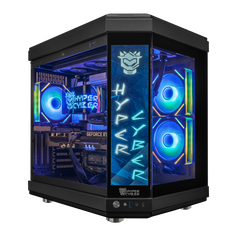
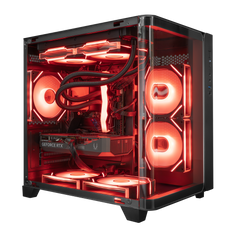
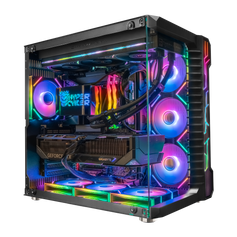
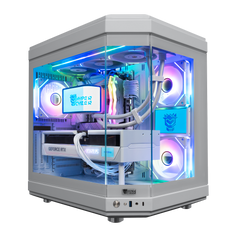
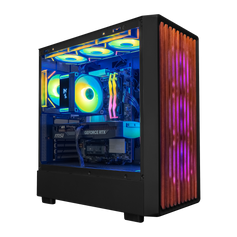
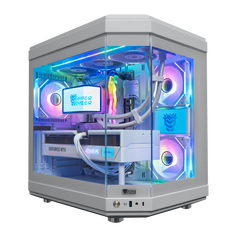

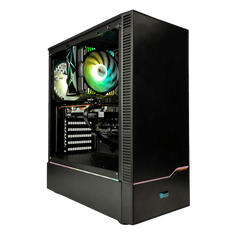
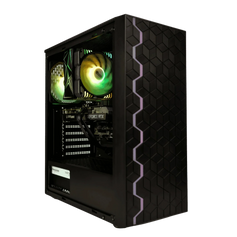

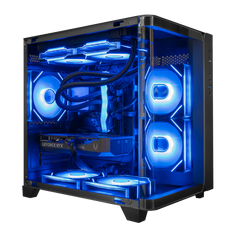
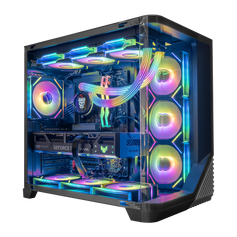
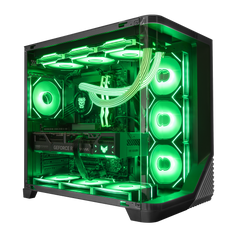
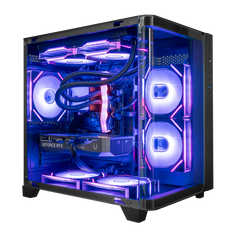
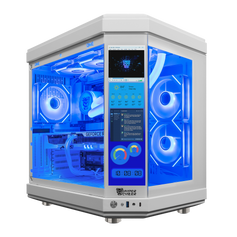
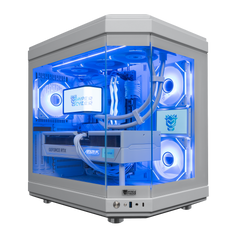






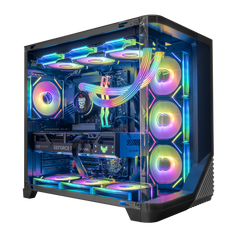
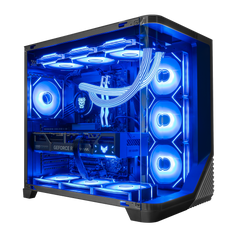

The GPU (Graphics Processing Unit) is the component that renders frames – drawing the 3D scenes, effects, and UI you see on screen. In gaming PCs, the GPU is usually the single most important part for determining FPS, visual quality, and resolution.
What the GPU Does in Games
The GPU handles:
- rasterizing 3D scenes into 2D images
- shading pixels and applying lighting
- handling textures, shadows, and post‑processing
- accelerating ray tracing on modern cards
- upscaling and frame generation (DLSS, FSR, etc.)
A stronger GPU lets you:
- run higher resolutions (1440p, 4K)
- turn up graphics settings and ray tracing
- maintain higher FPS in demanding titles
That’s why so much of a gaming budget typically goes toward the graphics card, and why systems are often grouped as NVIDIA gaming PCs or AMD Radeon gaming PCs.
Choosing the Right GPU
Good rules of thumb:
- For 1080p high refresh, mid‑range GPUs in esports gaming PCs are ideal.
- For 1440p Ultra, look at stronger RTX and Radeon tiers.
- For serious 4K gaming, high‑end GPUs belong in premium 4K gaming PCs.
It’s also important to consider VRAM, since higher resolutions and textures consume more video memory. A powerful GPU with too little VRAM can struggle at its intended settings.
Related Concepts
- CPU – Feeds the GPU with game data; both must be balanced for best performance.
- VRAM – Dedicated GPU memory that stores textures and buffers for each frame.
- FPS – The core metric of how many frames the GPU can render per second.
- Ray Tracing – Advanced lighting technique heavily dependent on GPU power.


