
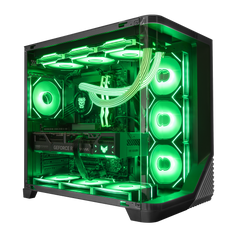
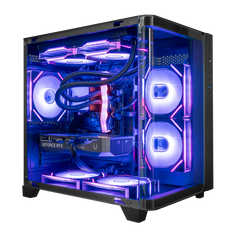
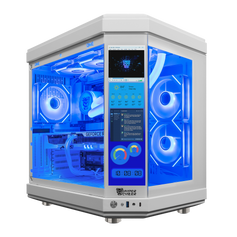
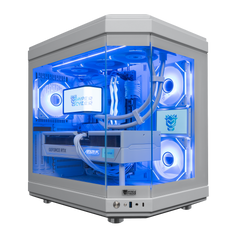




NVMe stands for Non-Volatile Memory Express. It's a storage protocol designed specifically for flash-based storage, allowing solid-state drives to communicate directly with the CPU through the PCIe interface rather than through the older SATA pathway. The result is a storage device that is dramatically faster than a traditional hard drive or SATA SSD – and one that has become the standard choice for gaming PC builds at every price point.
When people refer to an NVMe SSD, they mean a solid-state drive that uses the NVMe protocol over a PCIe connection, typically in an M.2 form factor – a compact stick roughly the size of a stick of gum that plugs directly into the motherboard.
How NVMe Works
Traditional SATA SSDs use a communication protocol originally designed for spinning hard drives. It works, but it's a bottleneck – SATA maxes out at around 600 MB/s sequential read speed regardless of how fast the flash storage beneath it is.
NVMe removes that bottleneck by talking directly to the CPU via PCIe lanes. This allows NVMe drives to reach speeds that SATA simply cannot:
- SATA SSD: ~550 MB/s sequential read
- NVMe Gen3 SSD: ~3,500 MB/s sequential read
- NVMe Gen4 SSD: ~7,000 MB/s sequential read
- NVMe Gen5 SSD: ~14,000 MB/s sequential read
Beyond raw speed, NVMe also reduces latency and supports far higher queue depths than SATA – meaning it handles many simultaneous read/write requests more efficiently, which matters in gaming and multitasking scenarios.
Why NVMe SSDs Matter for Gaming
For gaming, NVMe storage delivers improvements in several areas:
Load Times The most immediate benefit. Games stored on an NVMe SSD load significantly faster than those on a SATA SSD or HDD. Open-world games with large streaming assets – like Microsoft Flight Simulator or Cyberpunk 2077 – show the most dramatic improvements.
Texture and Asset Streaming Modern games stream assets dynamically as you move through the world. Faster storage means textures, geometry, and audio load before you reach them, eliminating pop-in and stuttering caused by storage bottlenecks.
DirectStorage Microsoft's DirectStorage API allows games to stream assets directly from an NVMe SSD to the GPU, bypassing the CPU entirely. This technology – supported in recent titles – dramatically reduces load times and allows much larger, more detailed game worlds. DirectStorage requires an NVMe drive to function; SATA SSDs are not compatible.
Windows and Application Performance Beyond gaming, an NVMe SSD as your boot drive makes everything faster – Windows startup, application launches, file transfers, and system responsiveness all improve noticeably.
For players building or buying a custom gaming PC, an NVMe SSD as the primary drive is essentially non-negotiable at this point. Even entry-level gaming PCs under $2,000 ship with NVMe storage as standard.
Real-World Example
Loading into a match in Battlefield 2042 on a traditional SATA SSD takes around 45–55 seconds on a typical system. The same system with an NVMe Gen4 drive cuts that to 18–22 seconds. On a system with DirectStorage support, supported titles can reduce initial load times even further – and in-world streaming becomes essentially seamless.
For flight simulation enthusiasts, where Microsoft Flight Simulator regularly streams gigabytes of terrain and scenery data in real time, a fast NVMe drive is as important as the GPU. It's why purpose-built PCs for flight simulation are configured with high-speed NVMe storage.
NVMe Form Factors
Most NVMe SSDs use the M.2 form factor, which slots directly into a dedicated M.2 port on the motherboard. M.2 drives come in different lengths – 2280 (22mm wide, 80mm long) being by far the most common.
Some high-performance and enterprise NVMe drives use the PCIe add-in card (AIC) form factor, plugging into a standard PCIe slot. These are less common in consumer gaming builds but offer the same NVMe protocol advantages.
One important note: not all M.2 drives are NVMe. Some M.2 slots and drives use the SATA protocol – physically the same connector, but with SATA's speed limitations. Always verify that a drive is NVMe (PCIe) rather than M.2 SATA when purchasing.
NVMe Generations: Gen3, Gen4, and Gen5
NVMe performance scales with the PCIe generation the drive uses:
|
Generation |
Max Sequential Read |
Real-World Benefit |
|
NVMe Gen3 |
~3,500 MB/s |
Excellent for gaming; significant upgrade from SATA |
|
NVMe Gen4 |
~7,000 MB/s |
Ideal for gaming and content creation; current mainstream standard |
|
NVMe Gen5 |
~14,000 MB/s |
Maximum performance; best for professional workloads and future-proofing |
For most gaming use cases, NVMe Gen4 hits the sweet spot – fast enough to fully leverage DirectStorage, eliminate load time bottlenecks, and handle demanding streaming workloads, at a price that's now very accessible. Performance PCs under $3,000 routinely include Gen4 NVMe as standard.
NVMe Gen5 offers the highest throughput available today and is worth considering for content creators, streamers, or anyone working with large file volumes alongside gaming. Higher-end NVIDIA RTX gaming PCs increasingly ship with Gen4 or Gen5 NVMe to match the rest of the system's performance tier.
How Much Storage Do You Need?
Modern games are large – and getting larger. A single title like Call of Duty: Modern Warfare III can exceed 200GB. Consider:
- 500GB – Minimum; you'll constantly manage space
- 1TB – Comfortable for most gamers with a rotation of active titles
- 2TB – Recommended for large game libraries, streaming setups, or content creation
- 4TB+ – Ideal for large libraries or combined gaming and professional use
Many builds pair a 1TB or 2TB NVMe primary drive with a secondary larger drive for storage overflow.
Related Concepts
- NVMe Gen5 – The latest generation, delivering up to ~14,000 MB/s
- PCIe 4.0 – The interface standard that enables Gen4 NVMe speeds
- PCIe 5.0 – The interface required for Gen5 NVMe performance
- Motherboard – Determines which NVMe generations are supported
- Bottleneck – A slow storage drive can create its own performance bottleneck in streaming-heavy games
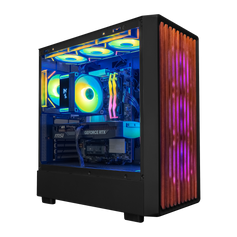
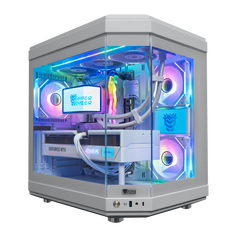
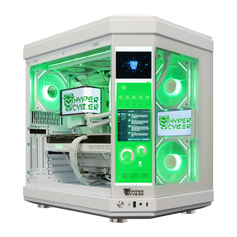
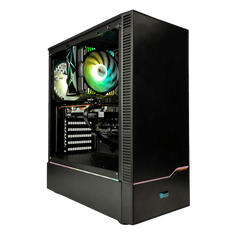
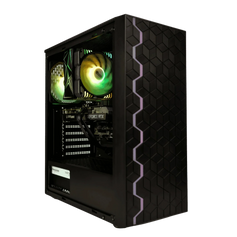
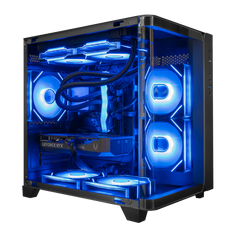
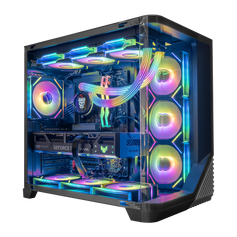
Every gaming PC in our lineup ships with NVMe storage as standard. Browse our full range of gaming PCs or configure your own with our custom PC builder.


