
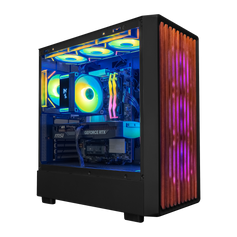
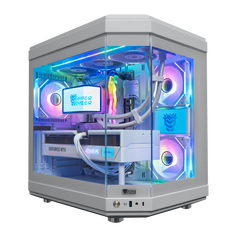
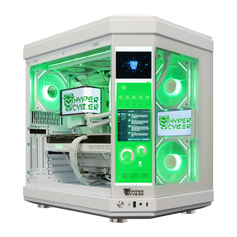
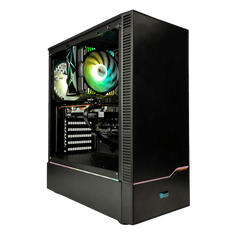



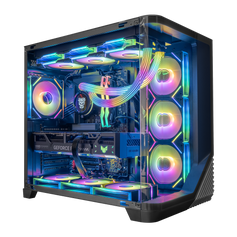
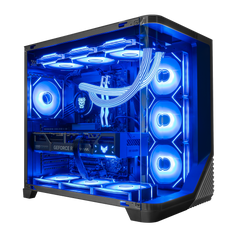


Short answer: the RTX 5070 Ti is worth the extra money when you want more headroom for demanding settings, higher resolutions, GPU-accelerated creation, or a longer useful runway from its 16GB memory buffer. For a 1440p-focused gaming PC, the RTX 5070 can be the more balanced choice, especially when the savings improve the CPU, storage, monitor, or overall build quality.
The right choice is not the card with the longer name. It is the complete system that fits your monitor, games, settings, and workload. This guide compares verified NVIDIA reference specifications and explains where the hardware difference matters without promising a fixed frame rate.
RTX 5070 vs RTX 5070 Ti at a glance
| Reference specification | GeForce RTX 5070 | GeForce RTX 5070 Ti |
|---|---|---|
| Architecture | NVIDIA Blackwell | NVIDIA Blackwell |
| CUDA cores | 6,144 | 8,960 |
| Graphics memory | 12GB GDDR7 | 16GB GDDR7 |
| Memory interface | 192-bit | 256-bit |
| Total graphics power | 250W | 300W |
| NVIDIA reference system power | 650W | 750W |
| Ninth-generation NVENC | 1 encoder | 2 encoders |
| DLSS feature support | Super Resolution, Ray Reconstruction, Frame Generation, Multi Frame Generation | Super Resolution, Ray Reconstruction, Frame Generation, Multi Frame Generation |
Source: NVIDIA GeForce RTX 5070 family specifications. NVIDIA bases its reference system-power figures on a Ryzen 9 9950X system. Add-in-card dimensions, clocks, cooling, and complete-system power requirements vary by manufacturer and configuration.
The table makes the decision clearer. Both GPUs use the same architecture and support the same core GeForce feature family. The RTX 5070 Ti is not a different generation; it is a larger implementation with more compute resources, more memory, a wider memory interface, a second encoder, and higher reference power.
Choose the RTX 5070 for a balanced 1440p build
The RTX 5070 is the sensible starting point when 1440p is the main resolution and the rest of the budget still matters. Its 12GB of GDDR7, lower 250W reference graphics power, and full Blackwell feature set make it easier to build around than the Ti. That can leave room for a stronger gaming CPU, more storage, quieter cooling, or the monitor that will actually display the experience.
High-refresh gaming does not turn every purchase into a GPU-only decision. Competitive games can become CPU-limited, especially at lower resolutions or reduced settings. In that situation, moving from the RTX 5070 to the Ti may change less than improving the processor, memory setup, or monitor. The exact result still depends on the game, patch, settings, and complete configuration.
Choose the RTX 5070 when most of these are true:
- Your main monitor is 1440p.
- You are comfortable adjusting the heaviest settings in demanding games.
- Ray tracing and upscaling are useful options, not a requirement at maximum settings in every title.
- You would rather spend part of the budget on the CPU, SSD, memory, cooling, or display.
- Your creator workload does not depend on the Ti's larger memory buffer or second encoder.
Choose the RTX 5070 Ti for more GPU and memory headroom
The RTX 5070 Ti adds 4GB of graphics memory, a 256-bit memory interface, and substantially more CUDA cores. Those are concrete hardware differences. They give the Ti more room for demanding graphics settings, higher-resolution assets, ray-traced workloads, and GPU-accelerated creation without relying on a marketing promise about one game.
The 16GB memory buffer is the clearest long-term distinction. More graphics memory does not create performance by itself, and unused memory has no benefit. It becomes valuable when a game, mod pack, texture set, rendering scene, or creator application needs more than the RTX 5070's 12GB buffer can comfortably provide.
The Ti also lists two ninth-generation NVIDIA encoders instead of one. Both cards support AV1 encoding, but the extra encoder capacity can matter more for video production and certain multi-stream or export workflows than it does for a straightforward gaming setup.
Choose the RTX 5070 Ti when most of these are true:
- You want more headroom for demanding 1440p settings or higher-resolution gaming.
- Four gigabytes of additional graphics memory helps the games, mods, or applications you actually use.
- You plan to keep the same GPU through several demanding software cycles.
- GPU rendering, video work, or another accelerated workload can use the additional resources.
- The Ti premium does not force a weaker CPU, smaller SSD, lower-quality power supply, or worse monitor elsewhere in the build.
What changes at 1080p, 1440p, and 4K?
1080p and competitive high refresh
At 1080p with competitive settings, CPU selection and game engine behavior can matter as much as the GPU step. An RTX 5070 paired with a strong gaming CPU may be the better system than an RTX 5070 Ti paired with a weaker processor. Match the build to the game and monitor refresh rate instead of assuming the Ti always produces a visible improvement.
1440p
1440p is the natural decision point between these cards. The RTX 5070 is the balanced option when you want strong GPU capability without pushing every other part of the system down the priority list. The RTX 5070 Ti makes more sense when you use demanding settings, ray tracing, a high-refresh display, or creator applications that benefit from its larger memory and GPU resources.
4K
For a 4K-first system, the RTX 5070 Ti is the more comfortable place to start because it has 16GB of memory, a wider interface, and more compute capacity. That does not mean every game should run at maximum settings, and it does not make upscaling unnecessary. Game support, image-quality mode, ray tracing, and target refresh rate still determine the practical result. If 4K is the main goal, compare the full set of 4K gaming PCs rather than limiting the decision to one GPU badge.
CPU pairing: spend for the actual bottleneck
A GPU comparison is incomplete without the processor. High-refresh competitive games, simulation, strategy, and large online environments can put more pressure on the CPU. Higher resolutions and heavier graphics settings generally move more of the work toward the GPU.
For a mainstream 1440p build, a current six-core or eight-core processor can be a sensible partner for the RTX 5070 when the games do not need a higher CPU tier. For high-refresh or CPU-sensitive gaming, a stronger gaming-focused processor may be a better use of money than moving immediately to the Ti. For rendering, editing, code compilation, or heavy multitasking, a higher-core processor can matter alongside either GPU.
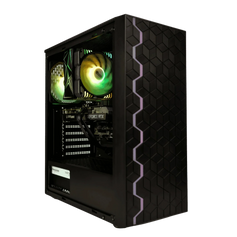
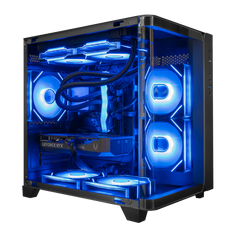
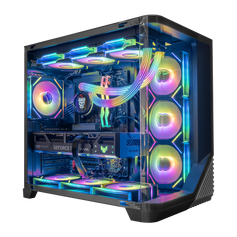
Do not pair every RTX 5070 Ti with the most expensive CPU by default. Start with the workload, then check the exact processor, memory, storage, power supply, and cooling on the product page. Hyper Cyber's current RTX 5070 and RTX 5070 Ti gaming PCs cover different CPU and storage tiers, so compare complete configurations rather than sorting only by GPU.
Power, cooling, and case fit
NVIDIA lists 250W total graphics power and 650W reference system power for the RTX 5070. The RTX 5070 Ti is listed at 300W total graphics power and 750W reference system power. Those system figures are references, not universal PSU rules. The installed CPU, card design, transient behavior, overclock, connectors, and other components can change the requirement.
The Ti's higher power also creates more heat that the case and cooling system must move. Check the exact graphics-card model, power supply, connector route, radiator or air-cooler placement, and intake/exhaust layout. A well-balanced RTX 5070 system can be preferable to a cramped or poorly matched Ti configuration.
So, is the RTX 5070 Ti worth the extra money?
Yes, when the extra hardware solves a real need. The Ti is the stronger choice for a 4K-first plan, demanding settings, heavier ray tracing, graphics-memory-sensitive games or mods, and creator workloads that can use 16GB and the second encoder.
No, when the upgrade weakens the rest of the system. For 1440p gaming, the RTX 5070 can be the better value if the savings produce a faster CPU for CPU-limited games, a larger SSD, better cooling, or a higher-quality monitor. The price gap must be judged at the complete-PC level because CPU, storage, memory, case, cooling, and support can differ between listings.
The practical rule is simple: choose the RTX 5070 when balance matters most; choose the RTX 5070 Ti when GPU and memory headroom are the priority.
RTX 5070 vs RTX 5070 Ti FAQ
How much more memory does the RTX 5070 Ti have?
The RTX 5070 Ti has 16GB of GDDR7, while the RTX 5070 has 12GB. The Ti also uses a wider 256-bit memory interface compared with 192-bit on the RTX 5070.
Is the RTX 5070 enough for 1440p?
It is a sensible 1440p-focused choice. The exact frame rate and settings depend on the game, CPU, patch, ray tracing, upscaling mode, and target refresh rate, so compare the complete system and the titles you actually play.
Is the RTX 5070 Ti better for 4K?
It is the stronger of the two for a 4K-first build because it has more GPU resources, 16GB of graphics memory, and a wider memory interface. Some games will still benefit from adjusted settings or upscaling.
Do both GPUs support DLSS and Multi Frame Generation?
Yes. NVIDIA's current specifications list both with DLSS Super Resolution, Ray Reconstruction, Frame Generation, and Multi Frame Generation. Available features and image-quality tradeoffs vary by game and selected mode.
Does the RTX 5070 Ti need a bigger power supply?
NVIDIA lists 750W reference system power for the RTX 5070 Ti and 650W for the RTX 5070, based on a Ryzen 9 9950X reference system. The exact PSU requirement depends on the complete configuration and the installed card model.
Should I buy a faster CPU or move from RTX 5070 to RTX 5070 Ti?
Choose the faster CPU when your main games are CPU-sensitive, your target is very high refresh, or the current processor would limit the system. Choose the Ti when resolution, graphics settings, ray tracing, memory demand, or GPU-accelerated work is the larger constraint.
Compare the full configuration
Browse current RTX 5070 and RTX 5070 Ti gaming PCs, compare the exact component list on each page, or configure a custom PC around your monitor, games, and workload.
Updated August 28, 2026. Technical specifications were checked against NVIDIA's current GeForce RTX 5070 family page. This article does not present vendor frame-generation examples as native-rendering benchmarks or as Hyper Cyber test data.


